Research in Fang group focuses on study of light-matter interactions and quantum optics at chip-scale, with an emphasis on developing quantum devices for applications in photonic quantum information processing, quantum sensing, and quantum networks. Current research includes:
- Quantum photonics
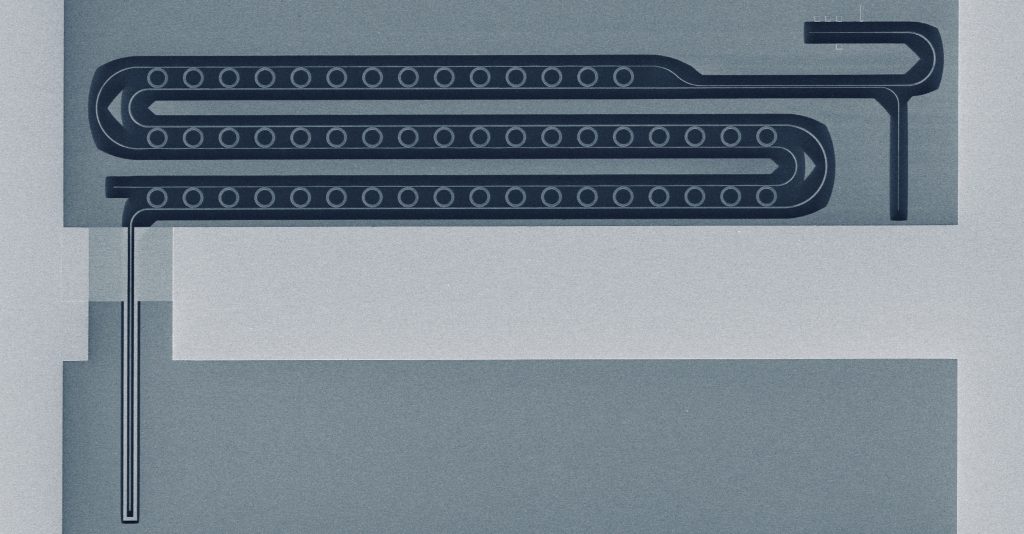
Photonic integrated circuits (PICs) with strong nonlinearity are an emerging platform for quantum information processing. We are exploring materials with substantial bulk nonlinearity and developing PICs to enable key resources and protocols for photonic quantum information processing and quantum networking.
- Optomechanics
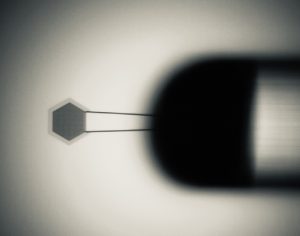
Control of phonons–quanta of vibrations–in engineered structures using radiation-pressure force represents an emerging quantum technique for sensing and information transduction. We are developing a new breed of chipscale optomechanical architecture based on mechanical bound states in the continuum to enable novel sensing modalities and quantum phenomena.
- Quantum devices
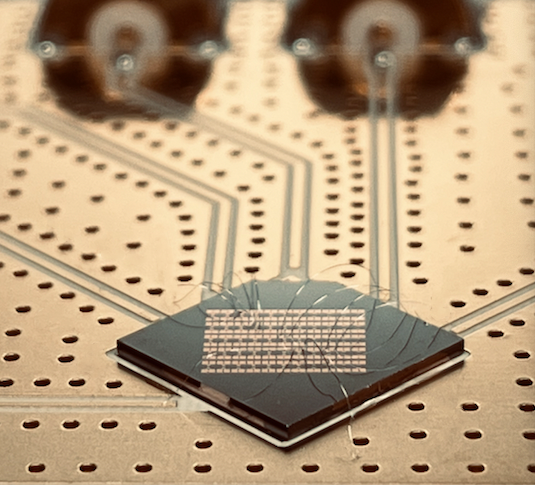
Phonons can couple with disparate physical systems, leading to hybrid quantum platforms that combine the advantage of individual components. With our collaborators, we are developing architectures and techniques to couple mechanical devices with superconducting qubits and neutral atoms.
Our lab is involved in two national quantum centers: NSF’s HQAN and DOE’s Q-NEXT.